




AI in Software Development: Insights from the YFM Portfolio
-
 AI & Emerging Tech What does a “good” finance function actually look like? Insights from across the YFM portfolio Part 2 of 2
 -
AI & Emerging Tech AI in Finance: Insights from the YFM portfolio Part 1 of 2
-
AI & Emerging Tech In an AI World, Talent Matters More Than Ever
-
AI & Emerging Tech How to Build an AI-Resilient SaaS Company: The Defensibility Test for Founders
-
AI & Emerging Tech AI in Go-To-Market: What Entrepreneurs Really Think
-
12:07
AI & Emerging Tech The Future of Business Intelligence: How AI is Transforming Due Diligence




AI is already changing how software teams work, but not always in the ways the headlines suggest.
To understand what’s happening day to day in our businesses, YFM recently brought together CTOs and CPOs from across the portfolio for a roundtable discussion on the practical realities of using AI in software development. Facilitated by Will Lytle of Plandek, the conversation focused on what teams are doing today, what’s working, what isn’t, and where the real challenges lie.
What emerged wasn’t a rush towards full automation. Instead, teams talked about a return to fundamentals to enable AI-assisted coding: sharper processes, clearer specifications, and more disciplined ways of working.
Adoption & team dynamics: what’s really happening
Most teams across the portfolio are already using AI in some form, but adoption is uneven, and often fragmented.
Developers have been quickest to get value from AI. In many businesses, over half of development teams are now using GenAI tools in their day-to-day work. Other functions, such as infrastructure, platform and software testing, are moving more slowly due to fewer obvious use cases, and fewer people actively championing AI within those teams.
For now, most AI use is informal. Teams are experimenting as they go, swapping tips with colleagues and learning what works in practice. A small number have put light guardrails in place around tool choice and usage, but being too rigid too early, or delaying trials to search for the ‘one tool to rule them all’, can actually slow progress. The sweet spot seems to be giving teams freedom to experiment, while creating opportunities to share learning and raise standards over time.
The starting point matters too. Teams working on new products or clean codebases find it much easier to experiment with AI-assisted development. In more established environments, legacy systems and older code can limit what AI tools can realistically do, which means progress tends to be slower and less consistent.
From AI support to AI autonomy
Despite rapid progress, AI that can operate fully on its own remains rare in practice.
Most teams are using AI in a supportive or supervised role across the software development lifecycle. No teams reported AI systems running end-to-end development tasks in production without human oversight. Concerns around code quality, consistency and long-term skill development remain key reasons for caution.
One recurring theme was the importance of structure. AI works best when tasks are broken down into clear, well-defined steps, something that benefits human developers just as much. Several participants noted that unstructured “vibe coding” rarely leads to software that’s ready for production.
The best advice:
Start by using AI as a support tool. Ask it to write specifications and clarify requirements with you before asking it to draft code. As processes mature and confidence grows, teams can then move gradually towards giving AI more autonomy.
Barriers & enablers: what really makes the difference
Across the group, the same challenges kept coming up when it came to scaling AI use:
- Legacy codebases and systems
- Inconsistencies in development processes
- Limited opportunity for sharing AI knowledge and standards
Effective use of GenAI relies heavily on good prompting, a skill that takes time to build and shouldn’t be assumed. Teams investing in AI literacy, training and internal champions are seeing faster, more sustainable progress.
Several CTOs also highlighted the value of “vibe coding” for proof of concept experimentation, rather than ull builds. Using AI to test ideas early and course-correct fast can significantly reduce wasted effort before committing to more complex solutions.
Best practice for using AI in software teams
Based on the discussion, a few clear principles stood out.
To encourage adoption
- Identify and empower internal champions
- Encourage experimentation, and enable open learning sharing
- Avoid ‘analysis paralysis’ on tool selection
To move towards more autonomous AI use
- Start by using AI in a support role before increasing autonomy and agentic use
- Clean up process and system fundamentals
- Use AI to improve specification-writing
To remove barriers
- Invest in AI literacy and training
- Standardise prompting where it helps
- Encourage vibe-coding experimentation to test ideas early, but be cautious about full builds
Metrics worth tracking
- AI adoption across teams
- Speed to market for new features
- Impact on customer outcomes and revenue
- Improvements in AI confidence and capability
Closing thoughts
AI is reshaping software development, but progress is slower than the headlines suggest.
The strongest outcomes come from getting the basics right: clear processes, good specifications, internal champions, and a willingness to experiment without losing control of quality or culture. For teams that take this approach, the opportunity isn’t just efficiency, it’s building better products, faster, and with greater confidence.




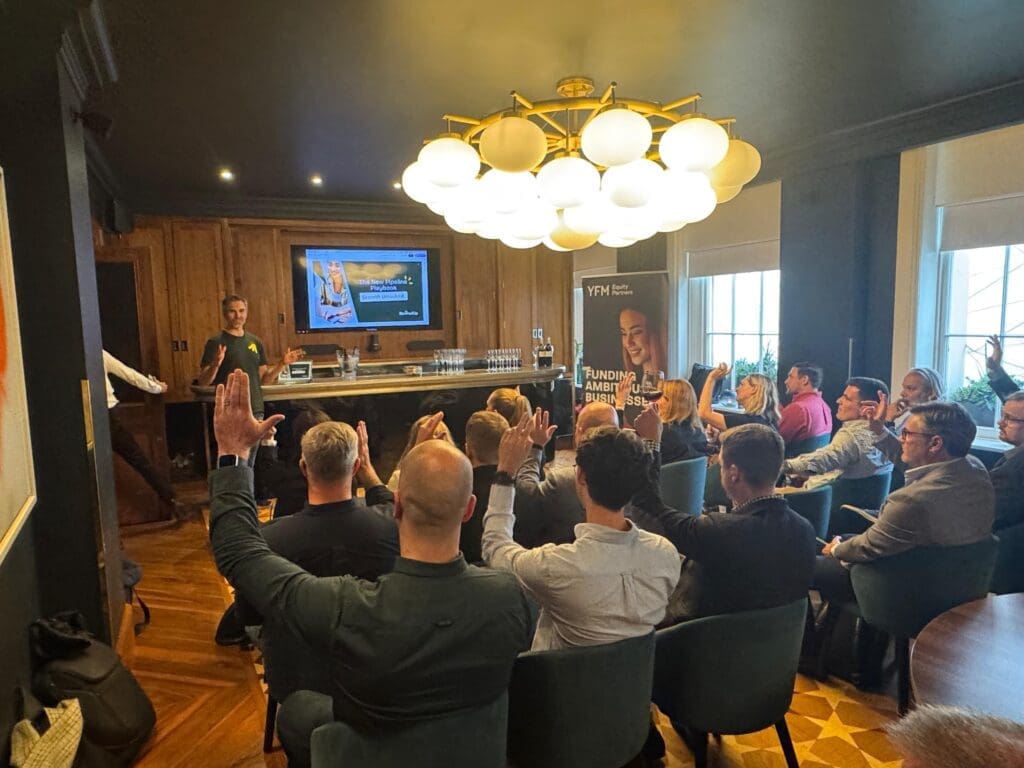
YFM recently hosted a portfolio event on AI in go-to-market, bringing together 19…
12:07

Chris Green, CEO of Xapien, shares insights on how AI is transforming business…