




Back
Part 2 of 3
Leadership due diligence: Building the culture that makes strategy work

-
 Leadership Leadership due diligence: Keeping teams aligned as companies scale Part 3 of 3
 -
Entrepreneur Lab New to PE: Lee Carlin, CEO, London Drainage Facilities Part 1 of 3
-
Entrepreneur Lab Leadership due diligence: what investors are really looking for Part 1 of 3
-
Entrepreneur Lab Open Letter: Strategy – Up, Down, And Done Properly Part 3 of 3
-
Entrepreneur Lab OPEN LETTER: What I Wish I’d Known About Boards Part 2 of 3
-
Entrepreneur Lab OPEN LETTER – When You Don’t Know What You Don’t Know Part 1 of 3


How founders and leadership teams can build genuine employee buy-in, create the conditions for open challenge, and turn strategy into action at every level of the business
In part one of this series, I highlighted the importance of clarity of strategic direction, so that employees know their role in bringing the strategy to life and the need for unity, dependability and cohesion across the organisation. In this second part, I want to get practical. Because knowing what good looks like is only useful if you know how to build it. Here, I explore two actions that can make a real difference: creating the conditions for genuine strategic dialogue, and building a culture where challenge is welcomed and feedback flows honestly.
In part one of the series...
I highlighted the importance of clarity of the company’s strategic direction, so that employees know their role in bringing the strategy to life. I emphasised the need for employees to be unified behind the strategy and to know that they can depend on their colleagues to their left and right to deliver on their parts. Businesses purr along more smoothly when interdependence has been achieved, when clunky and inefficient parts have been ironed out. Businesses who are in rapid scale mode have no time to lose, so cohesion and efficiency is of utmost importance, without it there is an unnecessary drag on limited resources.
In YFM’s Open Letter series with Rachel McCorry (CEO), Strategy – Up, Down, And Done Properly, she suggests that most businesses have a strategy but that very few have one that harnesses the business, is understood at every level, and consistently drives decisions and value creation.
She states that the CEOs job is to make sure that the strategy is clear enough that people understand it, relevant enough that they see how they contribute to it, ambitious enough to drive the business forward, yet grounded enough to achieve it. She summarises that strategy only matters if people understand it, remember it, and know how they personally contribute. Spot on. And whilst this is indeed crucial and is a significant part of what we assess in the due diligence process, unfortunately it’s not as easy as it sounds to achieve in practice.
One of the most common findings through the organisation and management due diligence process is that the leadership team is not communicating regularly enough and/or effectively enough about the company’s strategy, the tactical roadmap to accomplish this strategy and progress against achieving the strategic goals along the way.
Good intent to communicate is often there, however, the habit when under pressure with competing priorities is to revert to a ‘tell’ approach, where a one-way written or verbal statement is considered as having communicated sufficiently. Informing the troops is the typical modus operandi.
From the employee’s perspective, however, they have not been party to the wider discussions that occurred in the lead up to the final decision about the company’s direction or the more salient insights about the current state of play that occur during leadership meetings. They miss out on the valuable interchange that takes place further up the hierarchy or between founding team, Chair and investor. So, they often lack the necessary context when only high-level statements about company direction are subsequently issued.
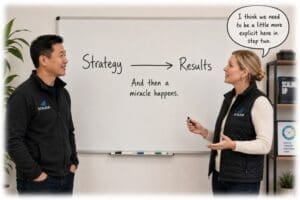
STRATEGIC DIALOGUE
More effective in the endeavour to align company goals with employee day-to-day actions is an opportunity for employees to engage in a dialogue about the strategic direction.
Not just to more fully understand the end decision that has been taken but to be informed about the other options considered, the pros and cons that were weighed up, the solutions that were put on the table and the reasons why a particular choice was made.
This is not so that the end decision can be challenged, it’s so that employees are not denied the learning curve that comes from the process of making the decision and are given a chance to equally own the decision, in a way that has meaning for them.
Rachel clarifies that strategy is nothing more complex than clear, deliberate choices about where to focus and how to win, made with discipline and intent.
If you give employees a chance to ask clarifying questions and to engage in a constructive dialogue about the company’s choices, they are more likely to buy-in to the decision made, more likely to feel a sense of unity behind the roadmap and more likely to better understand their team’s and their individual role in helping to get the strategy implemented.
It follows the well-known adage, ‘tell me and I’ll forget; show me and I may remember; involve me and I’ll understand’.
Whilst this may sound like taking up precious time to engage in a strategic dialogue, it’s a false economy NOT to engage in a regular exchange like this. More time will be spent making up for gaps later on, as people do their best to contribute but efforts are not focused or aligned and frustration and misunderstanding leads to missed deadlines, unhappy customers, unnecessary internal conflict or even employee churn.
Two practical actions can be undertaken to build a culture of mature and constructive dialogue that results in greater clarity and buy-in about the company’s strategic priorities.
PSYCHOLOGICAL SAFETY
For employees to ask clarifying or probing questions about the strategic direction and their role in it, they will need to speak up and make themselves vulnerable in an open session in front of their peers and team leaders. This is unlikely to occur if the work environment is not perceived to encourage open dialogue and healthy debate. The term psychological safety was coined by Harvard Business School Profession Amy Edmondson. She defines it as “the belief that one will not be punished or humiliated for speaking up with ideas, questions, concerns, or mistakes, and that the team is safe for interpersonal risk taking”. These elements are the lifeblood of entrepreneurial endeavours and scale-up companies, where test and learn should be part of the everyday.
In practical terms, this means feeling safe to contradict others, to ask questions, to ask for help, to admit mistakes and/or to share new or alternative ideas.
Hindrances include hierarchical behaviours, such as a company culture where seniority rather than objective data underpins decision-making. It’s evident when there is silence or compliance in meetings, where team members hesitate to contribute or challenge ideas. Fear of failure and a blame culture can prevail, discouraging individuals from taking risks or admitting mistakes. Such hesitancy slows down the ‘strategic speed’ that is essential for scaling enterprises.
Steps that founders and leaders can take to reduce the cost and increase the benefit of speaking up are to:
- Actively solicit more questions and make less one-way statements, encourage dialogue
- Provide multiple ways for employees to share their thoughts and responses e.g. interactive all-hands meetings with questions submitted in advance, live polls, employees being invited to lead some of the content, in their own way of engaging with the audience
- Show value and appreciation for ideas
- Promote healthy conflict
- Actively encourage the discipline of employees openly giving and receiving feedback
RADICAL CANDOR
On the topic of giving and receiving feedback, time and time again I come across the habit of founders, executives and team leaders avoiding tough performance conversations, because they don’t want to offend.
However, the cost of not providing constructive feedback is in fact higher for both the individual and the venture, due to delaying the inevitable. The individual is denied a learning opportunity, the chance to gain more clarity about expectations and to turn their performance around. The venture is not maximising results, just at the point where every resource has to be optimised.
A great investment for company culture and also for individual upskilling of team members is to promote ‘radical candor’ as the means of how to give clear and sincere feedback. Introduced by Kim Scott, author of Radical Candor: Be a Kick-Ass Boss Without Losing Your Humanity, she took her experience of managing teams in Silicon Valley and built a simple two-by-two matrix to guide the delivery of feedback:
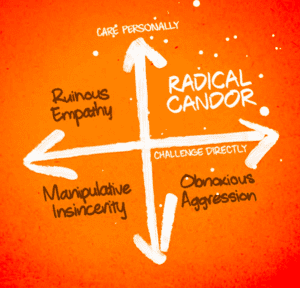
- High Care/Low Challenge is known as Ruinous Empathy. This is what happens when you want to spare someone’s short-term feelings, so you don’t tell them something they need to know. It’s the source of most regrettable mistakes
- High Challenge/Low Care is known as Obnoxious Aggression. Also called brutal honesty or front stabbing, it’s what happens when you challenge someone, but don’t show you care about them, leaving people feeling attacked
- Low Care/Low Challenge is labelled Manipulative Insincerity. It’s praise that is insincere, flattery to a person’s face and harsh criticism behind their back. Also called “playing politics.” Most commonly, talking about someone instead of talking to them. It’s the source of low-trust workplace cultures
To build a culture of radical candor (high care, high challenge), a few practical actions are to:
- Regularly ask for feedback, the best way to create an environment of trust and psychological safety
- Give specific and sincere praise in public, kind and clear criticism in private
- Share stories about feedback you’ve received, how you responded, and how it made a difference to you
- Encourage people to resolve issues directly before escalating
- Beyond modelling radical candor yourself, celebrate it when you see it in others, especially your peers in the leadership hierarchy
Looking ahead
As highlighted in the piece by YFM’s Jamie Roberts and Triple point’s Dominic Reason, Scaling Sustainably: What Happens After The Deal?, funding or acquisition creates the platform, but value is built through what happens next!
This article is the second in a three-part series exploring the people side of scaling. Across the series, Sonia Allinson-Penny shares insights from working with investors and portfolio companies, examining the leadership, team and organisational factors that can accelerate, or hinder, business success.
More articles in the series coming soon.
About the author
Sonia Allinson-Penny is the founder of Human Factor Health Check, a specialist people consultancy focused on leadership and team assessment for scaling organisations. Sonia works with investors and portfolio companies to evaluate leadership effectiveness, team dynamics and organisational readiness ahead of and during growth phases. She is also the author of a recently published book exploring the human side of entrepreneurial effectiveness, The Human Factors Behind Start-Up Success.




Part 1 of 3
An open letter to first-time PE-backed CEOs on boardrooms, blind spots and learning…

Part 1 of 3
Stepping into a PE-backed business as an incoming CEO is a different challenge…

Mentorship is the hidden driver of business growth. Gavin Chadwick, Investment Director at…
Part 3 of 3
In the final Open Letter, Rachel McCorry shares what she wishes she'd known…